Five Hilltop Buildings are Historic
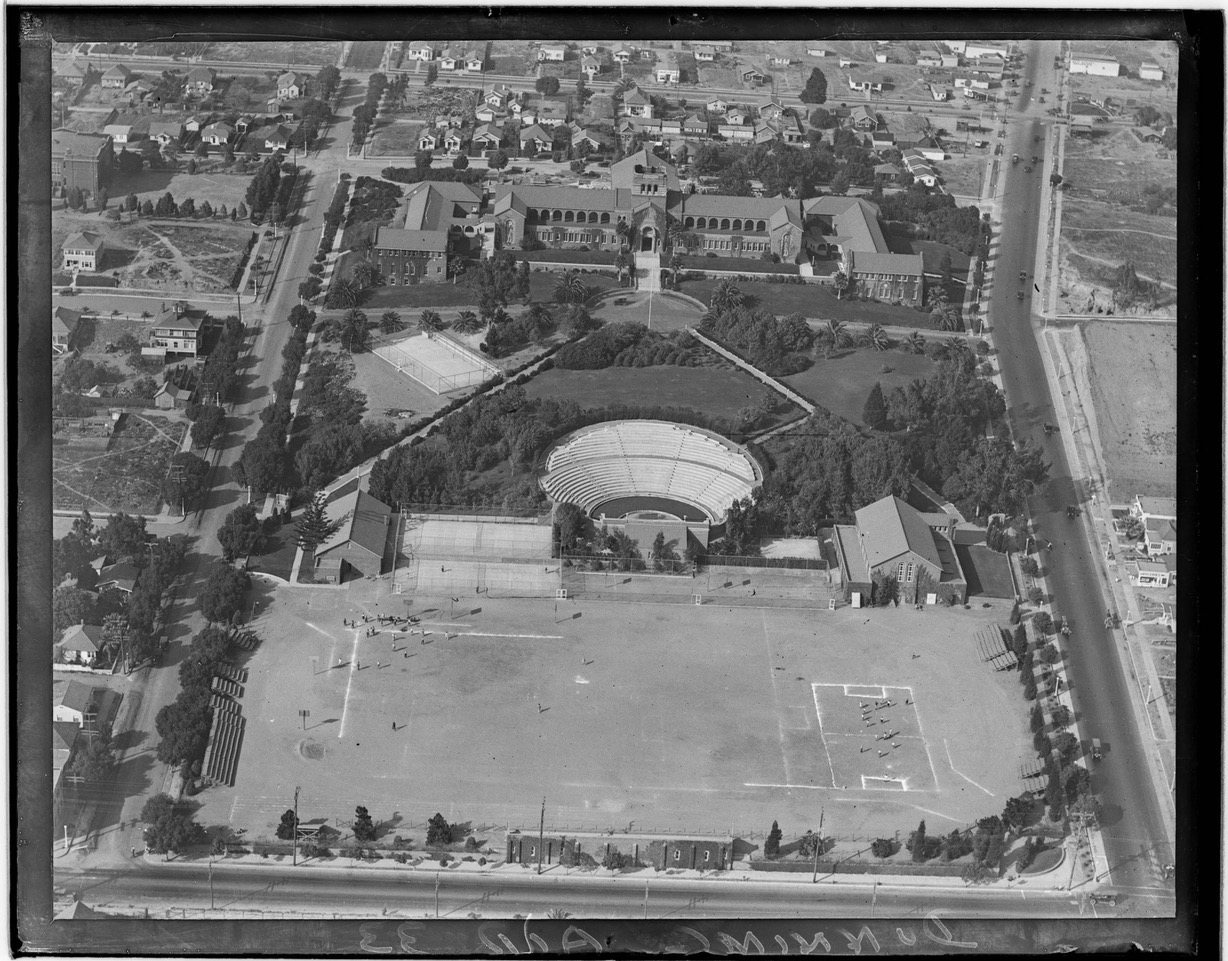
A cluster of historic buildings that form the historic core of Santa Monica High School is slated for demolition next year as part of a massive redevelopment and renovation of the campus. The School District plans for Santa Monica High School will not come before the Landmarks Commission because the school district is autonomous and distinct from the City of Santa Monica. School alumni and others, upset over the potential loss, have been signing a petition to save these buildings, with nearly 2500 signatures collected to date. The Santa Monica Conservancy is now asking the School Board to reconsider the demolition and instead, examine the possibility of rehabilitating and retrofitting these existing buildings.
Funds for the project derive from the passage of three taxpayer bonds passed between 2006 and 2018 totalling $1.138 billion dollars for improving school district facilities. To be phased over 25 years, the Samohi project proposes demolition of 17 out of 19 structures on campus including this particular cluster of 5 buildings, which are expected to meet the wrecking ball next summer.
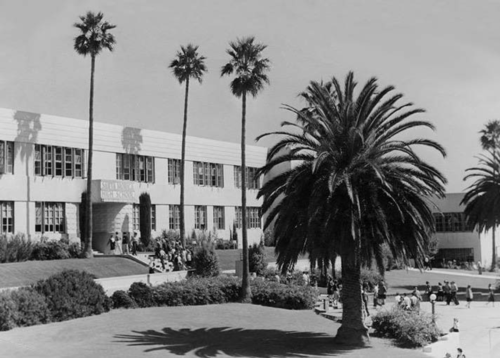
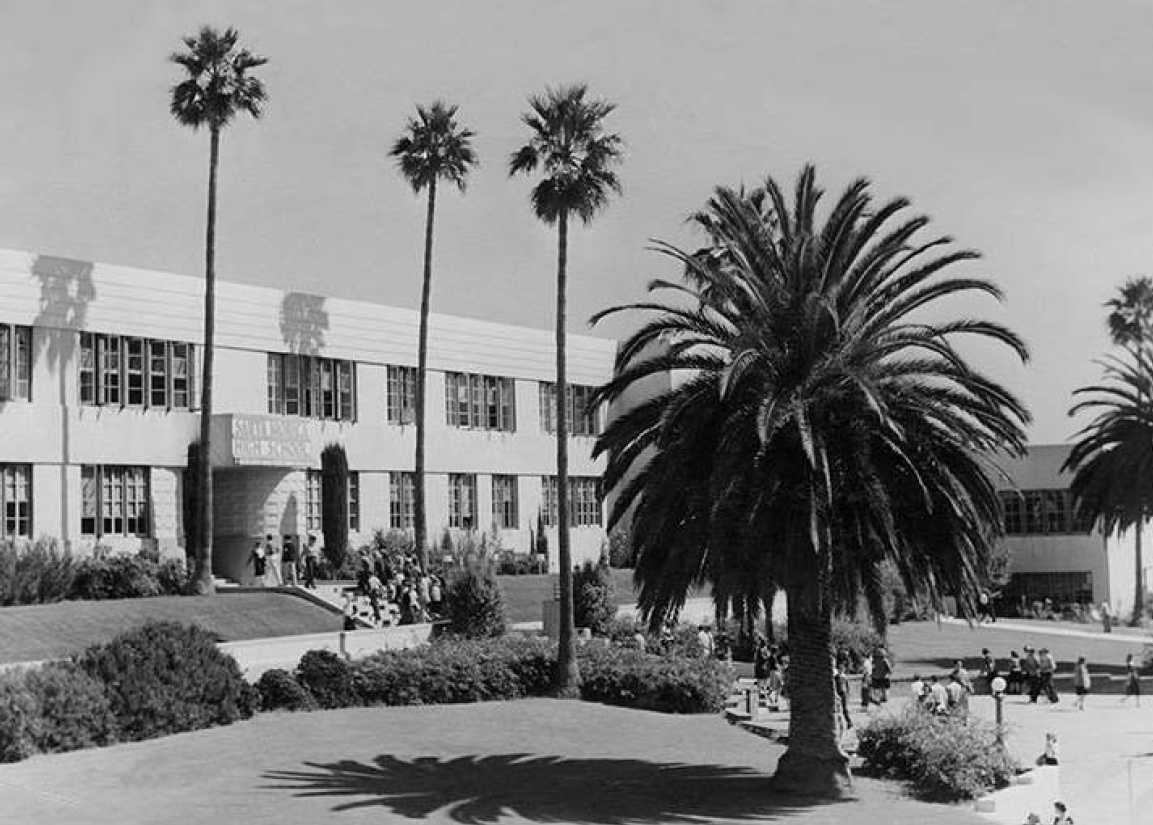
Samohi c. 1940. Photo: Santa Monica High School Campus Plan Historic Resources Technical Report, Historic Resources Group, July 2018
The Historic Core of the Santa Monica High School Campus constitutes a historic grouping that could become part of the Facilities Master Plan upgrades. The core consists of the English, History, Art, Business, and Business Annex Buildings, which retain their original 1913 location, WPA architectural character, and orientation atop Prospect Hill. By retaining the historic academic core of the campus, an opportunity to restore the original quad area as an open space that connects to the landmarked Barnum Hall and historic Greek Theater presents itself, enhancing the historic context of those two acknowledged, major historic resources.
Jump to what you can do here.
History of Samohi Buildings and Artworks
Sited atop Prospect Hill overlooking the coast and the city, two buildings (History and Business) were built in 1913 and a third (English) in 1924. This first phase was designed by ubiquitous architects Allison and Allison, who also built 12 buildings at UCLA, including Royce Hall, and countless other well-known public and commercial buildings. After incurring severe damage from the 1933 Long Beach earthquake, the Samohi academic buildings were reconstructed in 1937 and, in 1940 a Business Annex was added, all with federal funds from the PWA/WPA New Deal programs. This phase of development was executed by master architects Marsh, Smith and Powell, who specialized in schools and churches in the Los Angeles region. Barnum Hall, the Art Building, the North Gym, and seven artworks integral to some of the buildings were also added at that time. A Historic Resources Assessment created for the School District in 2018 noted that “Santa Monica High School has the distinction of being home of the highest concentration of WPA projects in the city.” Santa Monica High School is virtually a PWA and WPA museum, and the concentration of resources that embody that significance citywide and beyond, marks a key moment in the history of the high school and the school district.
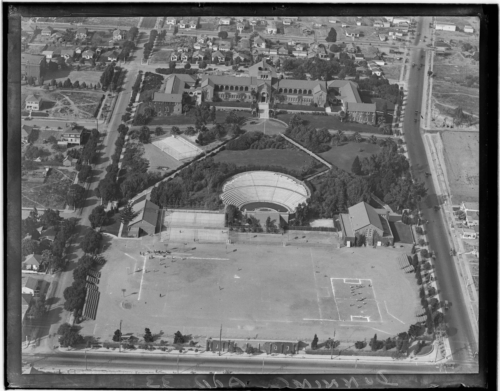
Aerial view of Samohi c.1920. Photo: Huntington Library, San Gabriel, California
Historic Assessment of Santa Monica Schools
The School District has commissioned two different historic assessment studies. A 2008 assessment found that the campus as a whole was highly significant and appeared to be eligible for the California and National Registers of Historic Places, and that two buildings within the cluster, the History and English Buildings, could be eligible for individual designation. It surveyed all 17 SMMUSD campuses and identified many significant structures throughout the school district. That report, which cost over $477,000, was abandoned in draft form and was never acknowledged as an official survey. A second assessment in 2018, never mentioning the existence of the first report, also found strong evidence that the campus was historically significant and deepened the narrative on the importance of the post-earthquake reconstruction. But the historic academic buildings on Prospect Hill were nonetheless dismissed as historic resources. These buildings as a small grouping were never considered, and as individual historic buildings the condition of their historic features were given short shrift.
The Historic Resources at Samohi Tell a Citywide Story
Both reports focused closely on the schools including the Samohi campus, and thus did not consider how important the PWA and WPA are to the history of the City of Santa Monica as a whole. This broader significance adds another layer to the significance of the cluster, and to its value as an educational resource on the school campus. The New Deal programs transformed the City of Santa Monica. Our entire beachfront was remade from a narrow dirt road with a train track to the Roosevelt Highway that connected our city directly up the coast all the way to Oregon. The New Deal programs rebuilt Santa Monica with the Arizona overpass from the top of Palisades Park, and the Olympic Tunnel that passes beneath Palisades Park, which is now part of the 10 freeway. The city also used the programs for a number of infrastructure projects like the Pier Bridge and the roadways beneath it, storm drains and street paving, the widening and enhancement of the California Incline, construction of City Hall, the Main Street Bridge, and several artworks including the library murals recently re-installed in our new main branch, and the Saint Monica statue at the foot of Wilshire Boulevard in Palisades Park. The list goes on and on. Nothing has impacted how the city has developed to the extent that the WPA and PWA projects in the city did since the railroads that were built here in the 1870s and 1890s.
Therefore, the concentration of these projects that remain intact on the Santa Monica High School campus are a very important cluster representing not only Santa Monica High School history but an important phase in the development of the entire city, and represent the deep impact of the New Deal programs nationwide. In that context, the concentrated cluster of historic resources on top of Prospect Hill is even more significant. This proposed historic cluster warrants further study for designation at the local, state, and national levels.
What You Can Do
Please help by urging the School District to reconsider the Samohi campus plans to replace the historic buildings, and consider an alternative which preserves and rehabilitates them, so our community’s history remains visible for us and future generations.
- Write to the School Board and the District Superintendent and ask them to halt next summer’s demolition so preservation experts can examine the possibility of rehabilitating and modernizing the historic buildings. Remind them that rehabilitation teaches sustainability, and honoring the past as we modernize for the future gives context and value to the study of history and culture. Tell them that historic school buildings throughout the region and state have been successfully modernized without demolition and have won awards for it.
- Virtually attend an upcoming school board meeting (1st & 3rd Thursdays) and ask to comment.
- Sign the petition to save the buildings.
- Join the Santa Monica Conservancy and increase the reach of your voice for preservation in Santa Monica.
- Urge others to take these actions; share this flyer.
More Information
Santa Monica Conservancy analysis of previous Santa Monica High School assessments
2008-1120-PCRDraftAssessmentAllCampusesSMMUSD-
Santa Monica High School Campus Plan Historic Resources Technical Report
Santa Monica High School Cultural Resources
High Schools all over the country are approaching major modernization projects by combining adaptive reuse with new construction. In the examples below you will see rehabilitated spaces in historic buildings that look very much like the interior spaces proposed for the Samohi Campus. They win architecture and educational awards and attain high LEED status levels as well.
Venice High School, Los Angeles, California
Beverly Hills High School, Beverly Hills, California
North Hollywood High School, North Hollywood, California
Jordan High School, Los Angeles, California
Huntington Park High School, Los Angeles, California
Alameda High School, Alameda, California
Roosevelt High School, Portland, Oregon
Grant High School, Portland, Oregon
Lincoln High School, Seattle, Washington
North High School, Denver, Colorado