Conservancy News

We are seeking nominations for our 2021 Preservation Awards, which will be announced at our Annual Meeting in late spring. Each year we honor exemplary projects and contributors to the preservation of Santa Monica’s architectural and cultural heritage.

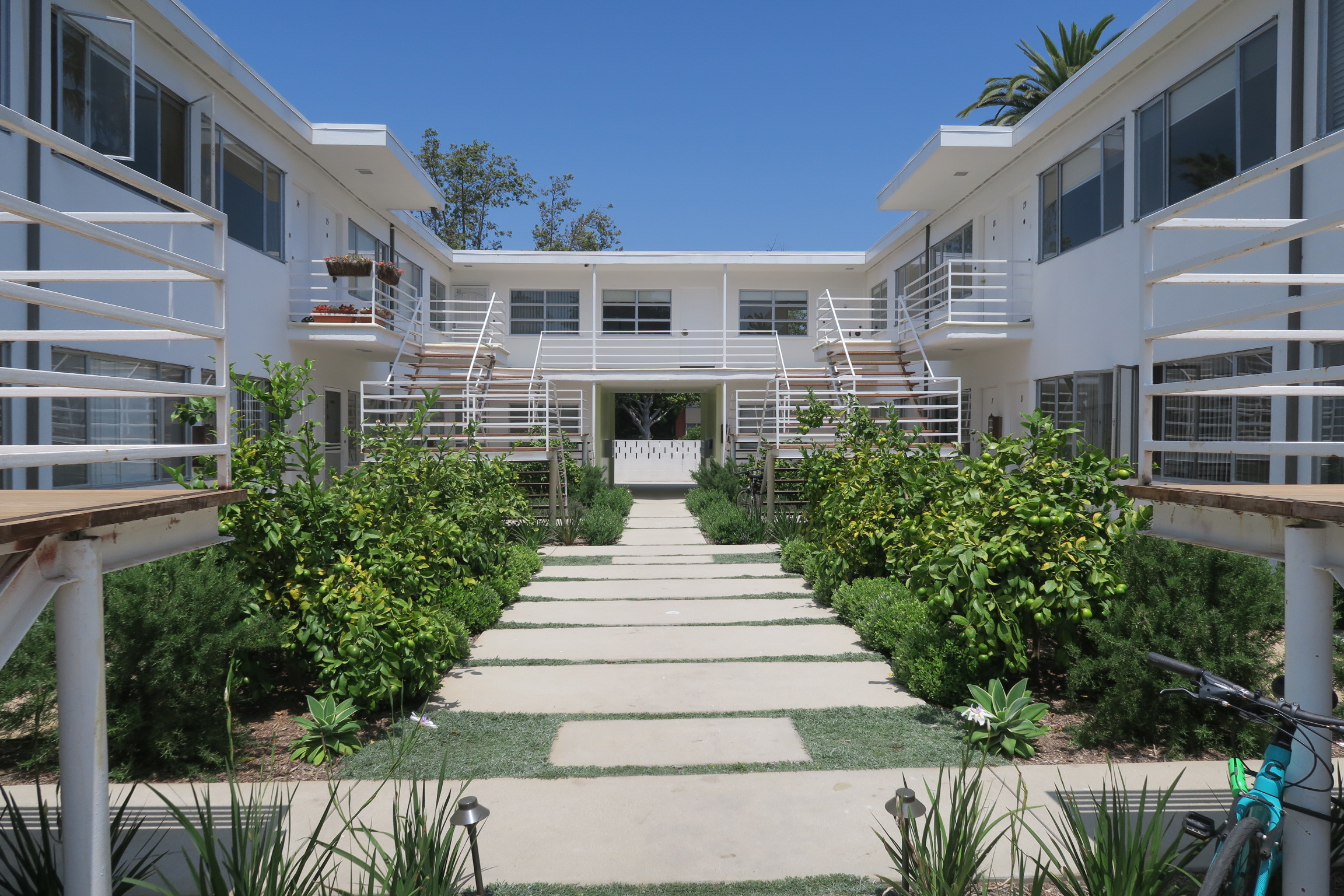
Awarded a 2020 Preservation Award, Villa Vicente is a two-story, 20-unit apartment building built in 1953. The project added long-term life to the historic property and represents the successful use of the Mills Act program in preserving and enhancing the historic resources of Santa Monica. Photo: Corsini Stark Architects

Since 2004, award-winning projects have included residences as well as commercial and institutional buildings of all sizes. These projects have entailed restoration, renovation, rehabilitation and adaptive reuse as well as additions to historic buildings and homes. Awards are also presented to individuals for their stewardship of historic properties as well as for community service as volunteers and advocates of preservation.

To nominate a project, person, structure or group for a 2021 Preservation Award, please download the 2021 Preservation Award Nomination Form and email it to awards@smconservancy.org. Include the name of the project or person and provide a brief statement about your nomination. The deadline for nominations is March 8, 2021. View all of our past awards here!

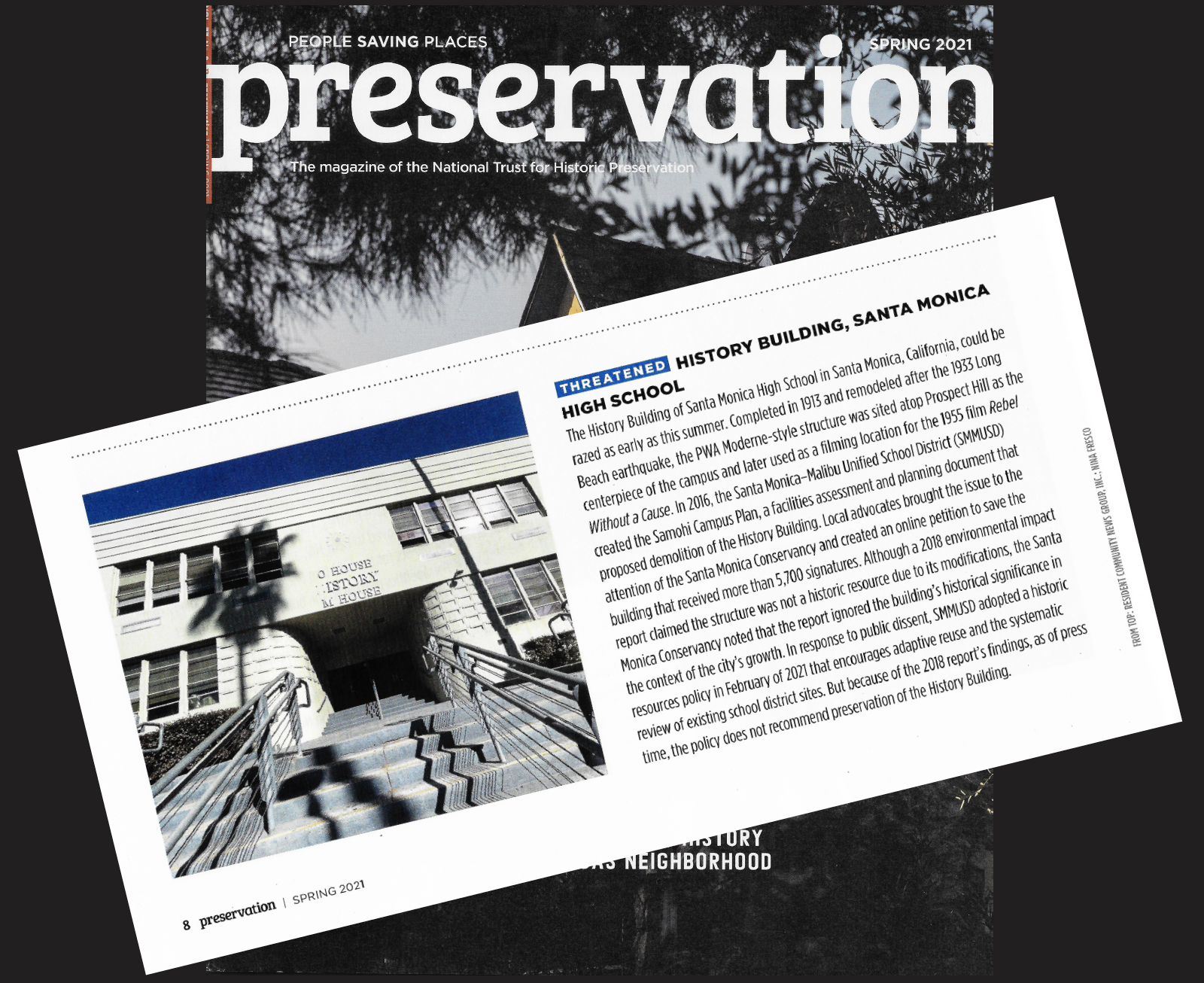
For months, the Conservancy and many community members have been asking the SMMUSD Board and staff to reconsider their plans to replace the History Building at Samohi with new construction. We have asked unsuccessfully for an evaluation of the options for rehabilitation of the historic structure by preservation professionals.

However, they have agreed to develop historic preservation policies and procedures for the other campuses. At the January 14, 2021 school board meeting, a first draft of a historic preservation policy will be discussed (click here to see agenda item).

The two basic elements of a viable historic preservation policy are:

  • A commitment to conduct a complete historic resources inventory of every school campus site;
  • A commitment to utilize the nation’s universal standards to preserve them: the Secretary of the Interior’s Guidelines for the Rehabilitation of Historic Properties.

Fundamental is the identification of historic resources at each site, which must be done ASAP – recent campus assessments calling for new construction and other improvements have already been formulated. The resources should be evaluated based not only on national and state designation standards as suggested in the draft, but also on the City of Santa Monica’s local designation criteria, which apply to our unique history and built environment. This will provide certainty and clarity about which buildings should be treated with sensitivity, and which may be altered or demolished. The inventory should be done in a public process to allow for input from stakeholders and interested parties citywide.

Once the full historic resources inventory of Santa Monica schools is completed, it should be adopted by the school board, and also sent to the California State Historic Preservation Office for their files. This would not mean designation of the resources but would ensure that when California Environmental Quality Act (CEQA) review of projects takes place in the future, the right resources are flagged.

Then the school district should commit to proper stewardship through appropriate policies. The Secretary of the Interior’s Standards should be applied to all work on listed structures. If demolition or significant alterations are proposed, the CEQA environmental review process involves analysis of alternatives, such as adaptive reuse, or project changes that avoid adverse impacts.

Please help the Conservancy convince the SMMUSD Board to adopt new historic preservation policies which:

  • Create a district-wide inventory of historic resources which they adopt;
  • Agree to utilize the Secretary of the Interior’s Standards to preserve them as much as possible;
  • Conduct an adaptive reuse study or evaluate alternatives to demolition if conflict arises between preserving a historic resource and educational program needs.

The Conservancy is currently working with district staff on this policy. Please show your support for our efforts by writing to the SMMUSD Board before 4 p.m. on January 14.

President’s Message

December 28, 2020

Dear Friends,

What a difficult year this has been for all of us. The pandemic has been very hard on our community but the new vaccines are greatly encouraging us in looking forward to returning to normal life. This year we’ve also witnessed a civil rights movement across the nation, which galvanized our Board to develop ways to transform our advocacy, programs and governance to be more equitable and representative.

With the cancellation of our many programs, the Conservancy was also hit hard this year, losing more than a 70% of our earned income, which would have been catastrophic without a dramatic response. In this challenging year, we’re incredibly grateful for adaptability, strength and the encouragement of our members, volunteers and staff.

But the brightest spot in this whole year has been YOU!

You – our members, friends and supporters – have inspired us with your fortitude, flexibility, generosity and deep caring. YOU are simply the reason we’re here and we’re so grateful that you are a part of our preservation community.

With you in mind, at the end of March, we began offering a weekly newsletter with exciting preservation news, virtual events and at-home activities. Many of you have told us just how much you appreciate the wide range of subjects expertly covered each week. With your support, we also launched our Santa Monica Mosaic lecture series, which has reached more than 350 guests and raised awareness about our historic Tongva, African American and Mexican American communities.

When the City made drastic cutbacks in its budget and services, crippling the Landmarks Commission, together we raised our voices about the importance of preservation. The Conservancy also took immediate action to fill these essential gaps. Our Advocacy Committee’s ongoing review of all proposed demolitions helps protect structures of historic value over 40 years old and we continue our strong efforts to save our historic places.

Your passion and commitment to preservation continue to empower us. Our Board, 21st Century Task Force and newly formed Advisory Council are all hard at work. And our Search Committee is moving forward with plans to hire our first full-time Executive Director in late 2021, which we will share more about in the new year.

We greatly look forward to the day when we can welcome you back to the Annenberg Beach House, our Preservation Resource Center and signature walking tour and programs in historic places along with our many other gatherings. And just as importantly, we can’t wait to have our treasured docents back to share their vast historical knowledge.

Again, thank you for your generosity and commitment. We look forward seeing you in 2021. Have a wonderful and safe new year!

Sincerely,


Tom Cleys
President, Board of Directors


I Love This Place! Premiere

December 17, 2020

Thank you for attending our virtual holiday celebration! We loved seeing you and your favorite historic places, sharing about our impact this year and previewing our exciting plans for 2021. We’re so glad that you joined us for this wonderful event, and we wish you a safe and happy holiday season!

Our I Love This Place! video is now available online. Please share and subscribe to our Santa Monica Conservancy Youtube channel!

by Sherrill Kushner

Historic preservation, like most professions and industries, uses jargon, special words or expressions that are particular to the field. What do we mean by adaptive reuse? What qualifies as a landmark? Such specialty words can confound the uninitiated.

To demystify some of our preservation language, see our illustrated glossary. Learn about adaptive reuse, contributing structures, demolition permits, designation, historic districts and landmarks, and fortify your knowledge about historic preservation today.

Adaptive Reuse: It’s like recycling! The process of reusing an old building or site for a purpose other than which it was originally built or designed for.

This World War II Quonset hut was awarded a 2013 Preservation Award for keeping its historic exterior intact while the interior was remodeled. Located at 829 Broadway in Santa Monica, today it houses Pono Burger.

This home and studio, a modest two-story, vernacular commercial building built in 1910, served as a neighborhood market for more than 60 years and was considered a teardown when purchased by artist Tony Berlant in 1976. Photo: India Bushnell


Contributing Structure: building or structure in a historic district that generally has historic, architectural, cultural, or archaeological significance, contributing to the whole district.

2612 3rd Street, a contributing structure to the Third Street Neighborhood Historic District . Photo: Benjamin L Ariff


Demolition Permit: a request to tear down a building in Santa Monica which, if approved by the City’s Planning Department, is issued to a licensed contractor for the work. For structures over 40 years old, a demolition permit may be issued 75 days from the date the application was submitted if no applications are received by the City to designate a building as a City Landmark or Structure of Merit.

Designation: A decision to identify and protect structures that have been determined worthy of preserving because they meet certain evaluation criteria.

Historic District: A definable area with a concentration of historic sites which are unified by plan, physical development or architectural character; or a non-contiguous group of thematically related properties.

San Vicente Boulevard Courtyard Apartments Historic District was designated in December 2015, becoming the third historic district in Santa Monica, joining the Third Street Neighborhood District and the Bay Street Craftsman Cluster.


Landmark:  a structure, improvement, natural feature or an object that is designated by the Landmarks Commission which is subsequently authorized to evaluate any proposed modifications that might detrimentally change, destroy or adversely affect the landmark’s exterior.

The the top floor of the Georgian Hotel on Ocean Avenue. The hotel was designated as a landmark in 1995. Photo: The Georgian Hotel


A landmark must meet one or more of these criteria, outlined in Chapter 9 of our Municipal Code:

  1. exemplifies, symbolizes, or manifests elements of our City’s cultural, social, economic, political or architectural history.
  2. has aesthetic or artistic interest or value, or other noteworthy interest or value.
  3. is identified with historic people or with important events in local, state or national history.
  4. embodies distinguishing architectural characteristics valuable to a study of a period, style, method of construction, or the use of indigenous materials or craftsmanship, or is a unique or rare example of an architectural design, detail or historical type valuable to such a study.
  5. is a significant or a representative example of the work or product of a notable builder, designer or architect.
  6. has a unique location, a singular physical characteristic, or is an established and familiar visual feature of a neighborhood, community or the City.

If you have any questions or would like to have more definitions provided in future emails, let us know. Send your inquiry to info@smconservancy.org.