Conservancy News

Would you like to join the enthusiastic and dedicated group of volunteers who have been offering guided tours of the Annenberg Community Beach House since it opened in 2009?

For the first time in several years, the Santa Monica Conservancy is opening a new training class for volunteers interested in being a docent at the Annenberg Community Beach House.

Become a Beach House Docent and learn about the three major people connected to the site – William Randolph (WR) Hearst, Marion Davies, and architect Julia Morgan – as well as stories of Hollywood in Santa Monica and the history of the Gold Coast beach.

Marion DaviesPhoto courtesy of Brian Thomas Jones

Docents are expected to work two three-hour shifts per month, offering tours of the Marion Davies guest house and the site. Interested candidates are advised to visit the Beach House and take a tour if they have not already done so. Trainees will attend three lectures in April, followed by on-site training. Prior experience as a docent is not required; one only needs an interest in interacting with people.

Docent training lectures will include the following program:

  • April 5: Writer Cari Beachamp on WR Hearst; historian Marc Wanamaker on Hollywood in Santa Monica and the glory days of Hearst and Davies.
  • April 12: Consultant Christy McAvoy on the history of the ACBH site; architect John Berley of Fred Fisher and Partners Architects, on the transformation of the site.
  • April 19: Film historian Elaina Archer will present her documentary on Marion Davies; docent Kay Pattison will discuss Marion and her relationship with Hearst.

The lectures will be held at Ken Edwards Center, 1527 4th Street from 2 – 4 pm. Parking is available on site as well as at Santa Monica Place. While the lectures are free for docent trainees, the public may attend for a donation of $10 per lecture or $25 for the 3 lecture series.  Space is limited.

The deadline for applications is Saturday, March 29.

To apply, click Docent Application for a form.  Once completed, mail your application form to Santa Monica Conservancy, P.O. Box 653 Santa Monica, California 90406-0653.  For additional questions, please contact info@smconservancy.org.


The landmark Georgian Hotel commemorated its 80th anniversary with a gala Old Hollywood-themed event benefiting the Conservancy on Wednesday, October 16, 2013. During this celebration, the hotel launched a unique fundraiser encouraging hotel guests to contribute to the preservation of historic properties in Santa Monica and raised $7200.

Georgian Celebration
“We wanted to celebrate the 80th Anniversary of the Georgian Hotel with more than just a party and we felt that the important work being done by the Santa Monica Conservancy needed to be celebrated as well,” explains Juan Viramontes, general manager of the Georgian Hotel.

Georgian Guests

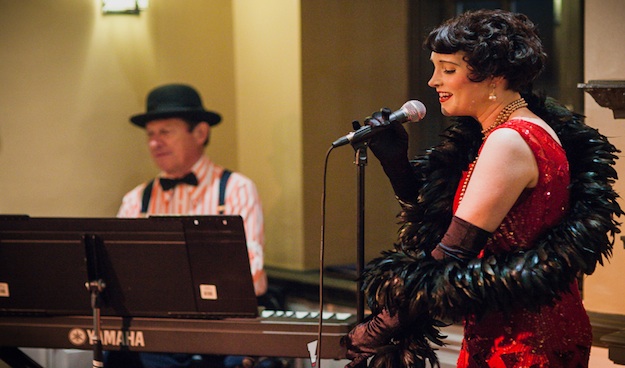
Guests were transported back in time with a nostalgic 1930s-style cocktail hour.  The party continued downstairs in the Georgian’s authentic prohibition-era speakeasy, where it is said that Bugsy Siegel, Al Capone, Clark Gable, Carol Lombard and “Fatty” Arbuckle once sought out exclusivity and seclusion.

Georgian Music

About the Georgian Hotel:  The Georgian’s story began as the coastal expansion of the late 1920s was reaching its peak.  Business woman Rosamond Borde hired architect Eugene Durfee to create a posh resort as an intimate hideaway catering to Los Angeles’ high society.  The Georgian, an art deco masterpiece completed in 1933, was one of the tallest and most prominent buildings in Santa Monica for decades. The oceanfront veranda provided a stage for martinis and jazz. The hotel was considered to be one of the most modern facilities of the time, featuring a beauty parlor, barber shop, playground and dining room.

The Georgian remained a favorite vacation residence after prohibition ended. Rose Kennedy spent several summers there in the 1960s entertaining Hollywood royalty, politicians and journalists. It continues to attract Hollywood celebrities such as Oliver Stone and Robert DeNiro.

The hotel was designated a City of Santa Monica landmark in 1995 and is featured on the Conservancy’s historic walking tour of Downtown Santa Monica.


The latest Conservancy newsletter is now available online, as well as past editions. Our newsletter covers upcoming preservation events, preservation issues, features on the people and places of historic Santa Monica and much more.

The newsletter is published four times per year. Conservancy members get mailed a copy of each new issue. Not a member? Join today!

Click here to download the current issue.

GTuesday2012

The second-annual #Giving Tuesday – a national day of giving back during the shopping and the spending of the holiday season – may have passed, but it is not too late to participate in the spirit of giving during this holiday season.

#Giving Tuesday shows that the holidays can be about both giving and giving back.  It celebrates giving…about ways to give more, give smarter, and put personal philanthropy back into the giving season.

Together, we’ll work to keep our historic places a vibrant part of the life and attractiveness of our city.

There are many ways you can support the Santa Monica Conservancy’s work on Giving Tuesday!

shotgunsign

  • Sign up to receive Conservancy news in email.
  • Come to a Conservancy event – our Holiday Party on December 7 is a great way to get to know us.
  • Offer your time as a Conservancy volunteer – be a docent, join our program or fundraising committee, or tell us how you’d like to contribute to our work.
  • Share a story about a historic place in Santa Monica: send email to us at info@smconservancy.org  or share it on Facebook.  Share a photo of yourself at your favorite historic place.
  • Share this with your friends and family so that they can learn more about the Conservancy.


The Conservancy was founded to promote understanding and appreciation of the benefits of historic preservation by offering educational programs, assistance and advocacy. We are known for our popular and informative docent-led tours of the Annenberg Community Beach House and weekly historic downtown walking tours, as well as events in historic private homes and neighborhoods, and an annual lecture series – each of which brings residents and visitors in closer touch with Santa Monica’s historic places.  We also work to ensure that historic preservation is a key objective in City plans, that owners receive incentives to preserve their historic structures, and that threatened buildings are saved and adapted for modern needs.

Our City’s historic places make Santa Monica a uniquely attractive beachside community, but we can’t take the survival of these special places for granted.  Decisions are made every day that put them at risk.

Thank you so much for your support!

Mills Act Incentives Threatened

The Mills Act, the state program that reduces property taxes on designated historic properties with approved restoration and maintenance plans, is Santa Monica’s only concrete incentive for historic preservation.  The Landmarks Commission has been working to improve Santa Monica’s application and monitoring process by proposing explicit standards that ensure that contracts fulfill the intent and public purpose of the Mills Act.  In March, the City Council will be asked to consider those recommendations, and to place limits both on the value of any individual contract and on the total value of contracts approved each year.

The Conservancy Board supports the Landmarks Commission recommendations, but is adamantly opposed to the proposed limits on the number and value of Mills Act contracts.  To date, 57 historic buildings have awarded these contracts, at an average cost to the city of $2,300 per contract per year.  The City’s total annual cost of this investment in the preservation of its historic properties is less than 0.3 % of property tax receipts!

Given Santa Monica’s high property values, some are concerned that the impact of the Mills Act on the City budget could be much greater in the future.  We believe that the data does not support that concern.  Fewer than 10% of the City’s properties are potentially eligible for the Mills Act, and only a small percentage of these are likely to seek designation.  Furthermore, we do not see evidence of a rush to apply.  In the 22-year life of the program, only two years – 2005 and 2006 – had more than 5 contracts approved.

Why, then, is the Conservancy so concerned about a cap on the contracts?  We believe it will create a disincentive to designate and apply for a contract because of factors out of the property owner’s control.  After investing the significant funds necessary to produce an application, the owner of a modest property could find that the number of submitted applications exceeds the cap and be forced to wait for some time to re-apply.  A limit on the value of a contract could also discourage a buyer from the purchase and rehabilitation of a valuable property in poor condition, resulting in another loss to Santa Monica’s historic character.

Please watch your email and the Conservancy website for additional discussion of this issue once the staff report is published!


New Zoning Ordinance

By Barbara Kaplan

The creation of a new Zoning Ordinance is an immense effort intended to incorporate the land use goals of the LUCE into a document that will govern growth in Santa Monica over the next twenty years. A subcommittee of the Landmarks Commission will work closely with the Commission as a whole, the Planning Commission, planning staff and members of the public to advocate for language in the ordinance that supports historic preservation. Along with the Santa Monica Conservancy, the group will work to include language that recognizes the importance of protecting historic resources in Santa Monica and that provides guidance, flexibility and incentives when any historic resource is a part of a building project.

In other reports, the Landmarks Commission has recently initiated actions on several historic resources. The Junipher Building, at 301 Wilshire Boulevard, was nominated for landmark designation last December 9, and is slated for review March 10. The Post Office building at Fifth and Arizona was nominated for landmark designation on January 13 and will also be considered March 10. The Home Savings Bank building at 2600 Wilshire Boulevard, with artwork by Millard Sheets, was designated a Santa Monica Historic Landmark in December, but has been appealed to the City Council. An appeal to overturn the designation of the Mayfair Theater terrazzo sidewalk paving at 210 Santa Monica Boulevard as Santa Monica’s 106th city landmark has been withdrawn. Lastly, the 100-year-old Bundy House at 401 25th Street was nominated for landmark status at the February Landmarks Commission meeting.

The Landmarks Commission is also pleased to congratulate the Santa Monica Conservancy and their perseverance in completing the entitlement process for the Shotgun House, a Designated Historic Landmark, thus allowing its relocation and restoration process to proceed.