Update: The 808 Woodacres hearing was continued at the request of the owner. It is currently scheduled for the Council Meeting on August 13. Please check the City Council agenda for any updates to that item.
The Conservancy’s nomination of John Parkinson’s residence at 808 Woodacres Road has been appealed by the owner and will be heard at the City Council Meeting on July 23rd, the same night as the 4th Street Corner Historic District. The Landmarks Commission voted unanimously for the designation, which was the focus of lengthy public hearings at their March and June meetings. The City’s consultant and two independent historic preservation firms (engaged by a neighbor who supports the nomination) all agreed that the residence met five of the six criteria for landmark designation.
To support this designation, send a message to councilmtgitems@smgov.net by noon on July 23.
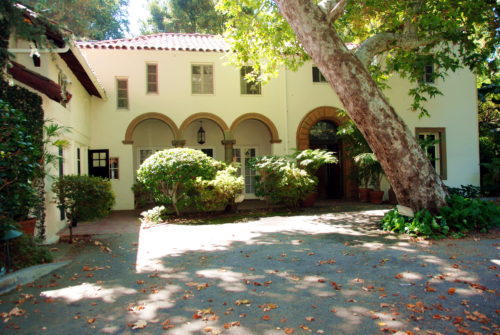
808 Woodacres Road. Photo: Michael Locke
This house is the only extant example of iconic architect John Parkinson’s residences that he designed for himself. Parkinson is most noted for designing the LA Memorial Coliseum, Bullocks Wilshire, Los Angeles City Hall (a collaboration), Union Station and numerous other commercial and institutional buildings in downtown Los Angeles and at USC.
The owner is strongly opposed to landmark status, believing that her property value will be reduced. We believe the opposite is true– a landmark building of this stature, a famous architect’s residence designed by him.
The Landmarks Commission rationale for the Landmark designation, and the findings that they made regarding meeting the City’s criteria for designation include the following:
(1) It exemplifies, symbolizes, or manifests elements of the cultural, social, economic, political or architectural history of the City.
The subject property exemplifies the City’s early architectural and development history. As one of the few extant residences from the earliest phase of residential development in this portion of the City located north of San Vicente Boulevard along the southern rim of the Santa Monica Canyon, the property is significant as an increasingly rare example of early residential development in Santa Monica. Constructed in 1920, the property is an early example of residential development in the area that would later expand during subsequent years after its construction. Although the property was located in the City of Los Angeles until its annexation to the City of Santa Monica in 1979, it was generally referred to in City directories and other publications as a property situated in Santa Monica because of its location, siting, and access. Purchased by master architect John Parkinson in 1913, the 22-acre site was later subdivided into a new residential tract in 1946.
Overall, the property retains a strong sense of time and place from the first quarter of the twentieth century as it remains an estate-style property of approximately 54,000 SF. Although the building and property have been altered over time, most of the alterations are along secondary elevations or at the rear of the main structure. Despite its minor alterations, the residence substantially retains all aspects of integrity from its period of significance (1920-1935) and continues to convey its architectural characteristics of the Spanish Colonial Revival and Italian Renaissance Revival styles. Furthermore, the siting of the residence and overall site characteristics as an estate property continue to convey its historic association and character within the City of Santa Monica. Accordingly, the subject property satisfies this criterion
(2) It has aesthetic or artistic interest or value, or other noteworthy interest or value.
The subject property is an excellent example of its type, design, and style. Its design fully articulates John Parkinson’s design principles of Period Revival architecture and expresses his aesthetic and artistic ideals of the period and style. Characteristics including the deeply recessed doors and windows, smooth trowel-finish stucco exterior walls, barrel clay roof tiles, arched shaped openings, the crafted use of glazed terra cotta tiles, and the integration of a loggia and arcade enclosed by ornate spiral fluted terra cotta decorative columns with Corinthian capitals further epitomizes the design theories of its architectural style that is of aesthetic and noteworthy interest. The subject residence consists of high aesthetic and artistic qualities and therefore satisfies this criterion.
(3) It is identified with historic personages or with important events in local, state or national history.
The subject property was designed by architect John Parkinson who was a self-trained architect considered one of most influential designers in the region at that time. Parkinson is best known for his civic, commercial, and hotel projects, however also designed industrial buildings and residential properties. Parkinson is considered an important person at the local, state, and national levels for his masterful architectural work and the design of extraordinary, iconic buildings that influenced and defined Los Angeles’ visual and physical identity during a period of unparalleled expansion during the first half of the twentieth century. By the time the subject residence was completed, John Parkinson was a well-established architect in the Los Angeles area with several large commissions. It was around this time in 1920 that he partnered with his son to form the architectural practice of Parkinson & Parkinson. The firm designed notable and influential buildings in Los Angeles further exemplifying Parkinson as a prominent and notable architect. The property is identified with master architect John Parkinson, and therefore satisfies this criterion.
(4) It embodies distinguishing architectural characteristics valuable to a study of a period, style, method of construction, or the use of indigenous materials or craftsmanship, or is a unique or rare example of an architectural design, detail or historical type valuable to such a study.
The subject property is an excellent example of its type, design, and style reflecting the Spanish Colonial Revival style with influences from the Italian Renaissance Revival idiom. Its design fully articulates John Parkinson’s design principles of Period Revival architecture and expresses his aesthetic and artistic ideals of the period and style. Characteristics including the deeply recessed doors and multi-pane fenestration, smooth trowel-finish stucco exterior walls, barrel clay roof tiles, arched shaped openings, the crafted use of glazed terra cotta tiles, and the integration of a loggia and arcade enclosed by ornate spiral fluted terra cotta decorative columns with Corinthian capitals further epitomize the design theories of its architectural style. Other features associated with Parkinson’s work are evident on the residence including the horizontal emphasis of the property’s overall design and the aesthetic composition, scale, and articulation of the façade. The residence substantially retains all aspects of integrity from its period of significance (1920-1935) and continues to convey its historic significance, embodying distinguishing architectural characteristics of the Spanish Colonial Revival and Italian Renaissance Revival styles valuable to a study of its type and style. Furthermore, the subject property is a rare example that exemplifies Parkinson’s residential design philosophy and is the only known single-family residence of its type designed, constructed, and resided in by John Parkinson within the City. Therefore, the subject property satisfies this criterion.
(5) It is a significant or a representative example of the work or product of a notable builder, designer or architect.
The subject property was constructed in 1920 and designed by master architect John Parkinson as his personal residence. Parkinson was a self-trained architect who is considered one of the most influential designers as his work is recognized throughout the Southern California region. He is best known for his civic, commercial, and hotel projects, however he also designed industrial buildings and residential properties. The architectural styles of these buildings included Art Deco, Spanish Colonial Revival, Italian Renaissance, Art Deco, Classicism, Romanesque, and Beaux Arts. Parkinson helped define Los Angeles’ visual and physical identity during a period of unparalleled expansion during the first half of the twentieth century. He designed more than 400 structures in the Los Angeles area, including but not limited to the Homer Laughlin Building (1897, Grand Central Market) in downtown Los Angeles, the Los Angeles Memorial Coliseum (1923), Los Angeles City Hall (1928), and Bullocks Wilshire (1928-1929). The subject property is a rare example that exemplifies Parkinson’s residential design philosophy and is the only known single-family residence of its type designed, built, and resided in by master architect John Parkinson within the City of Santa Monica. Therefore, the subject property satisfies this criterion.