Penguin Coffee Shop
- Known As
- Penguin Coffee Shop, Googie
- Architect
- Armet & Davis Architects
- Built
- 1959
- Designated
- –
ADVOCACY ALERT: The iconic Penguin Diner is threatened with demolition to make way for an 8-story apartment building. On December 14, 2026 at 7pm, the Landmarks Commission will hold a public hearing on a landmark application for the Penguin submitted jointly by the Santa Monica Conservancy and Los Angeles Conservancy. We must ensure Landmark Designation is approved for this last remaining example of the Googie style in Santa Monica, the work of renowned architects Armet & Davis in 1959.
Send a letter of support to the Landmarks Commission at planningcomment@santamonica.gov. Come to the hearing to give live testimony: 1685 Main Street, Room 250 (City Council Chambers) Santa Monica, CA 90401
Opened this from Facebook or Instagram? Tap the ⋯ menu and choose Open in browser for the buttons to work.
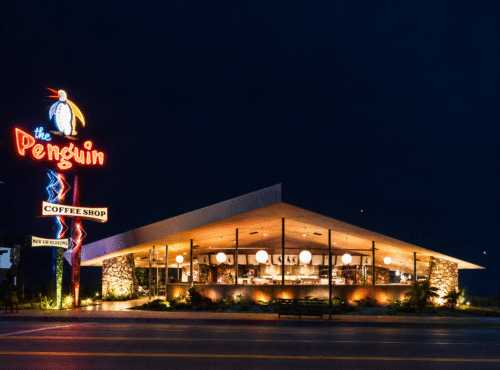
The Penguin Coffee Shop at 1670 Lincoln Boulevard is an outstanding and fully expressed example of a Googie style coffee shop designed by master architects Armet & Davis. It is the single surviving such example in Santa Monica representing the full manifestation of the Googie Coffee Shop Modern style, a distinct variant of modernism that flourished in the 1950s and 1960s, displaying the characteristic gravity-defying energy and flamboyance of Googie.
The Googie style is associated with the nation’s infatuation with the automobile, as its eye-catching flamboyant design, large neon signage, and use of light as a night-time visual attraction were intended to appeal to passing motorists. This was the era in which freeways began to dominate the American landscape, contributing to America’s passion for road travel, now at higher speeds. Many of the characteristic features of the Googie style are present in the Penguin including over-scaled, angular and floating roofs, thrusting dynamic forms, plate glass windows replacing walls, rough stone planes for textural contrast, highly illuminated interiors with floating light fixtures, use of plastics and terrazzo, merging of exteriors and interiors, and oversized eye-catching neon signs. Googie signage was elevated through scale and design to become a key feature of the overall architecture. It was often accented with neon lighting, and sometimes animated.
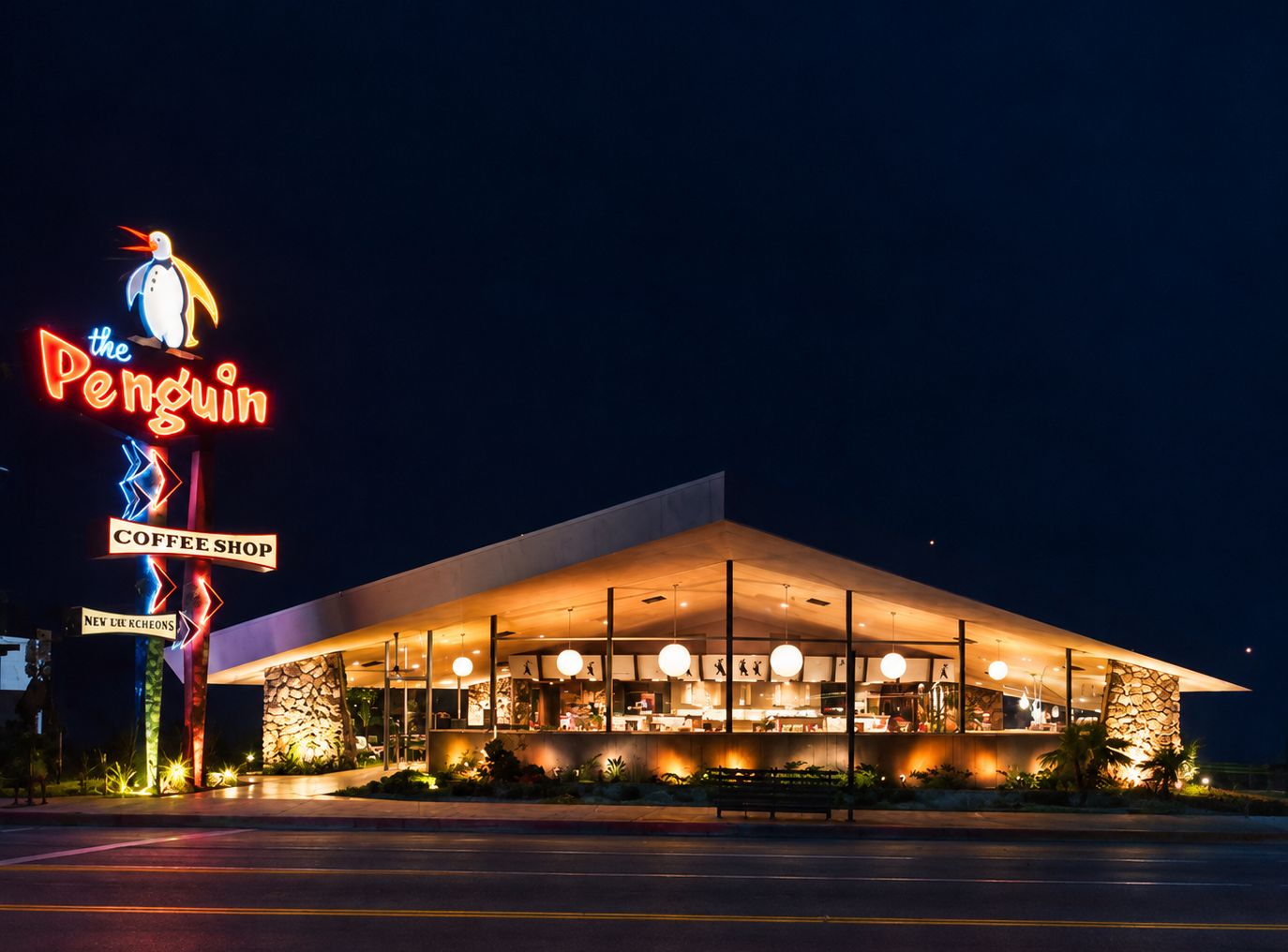 The Penguin Coffee Shop in 1959, designed by Architects Armet & Davis. Photo: Santa Monica Public Library, colorized
The Penguin Coffee Shop, operating as Mel’s Drive-In today, anchors the corner of Lincoln and Olympic Boulevards – the official terminus for Route 66, the Mother Road and the gateway to the city for motorists exiting the Santa Monica Freeway. This end-of-the-road beacon opened in 1959 as a 24-hour restaurant with coffee shop and a bar, operating for 30 years until the building became a dental clinic in 1991. In 2019, the shuttered facility was reborn.
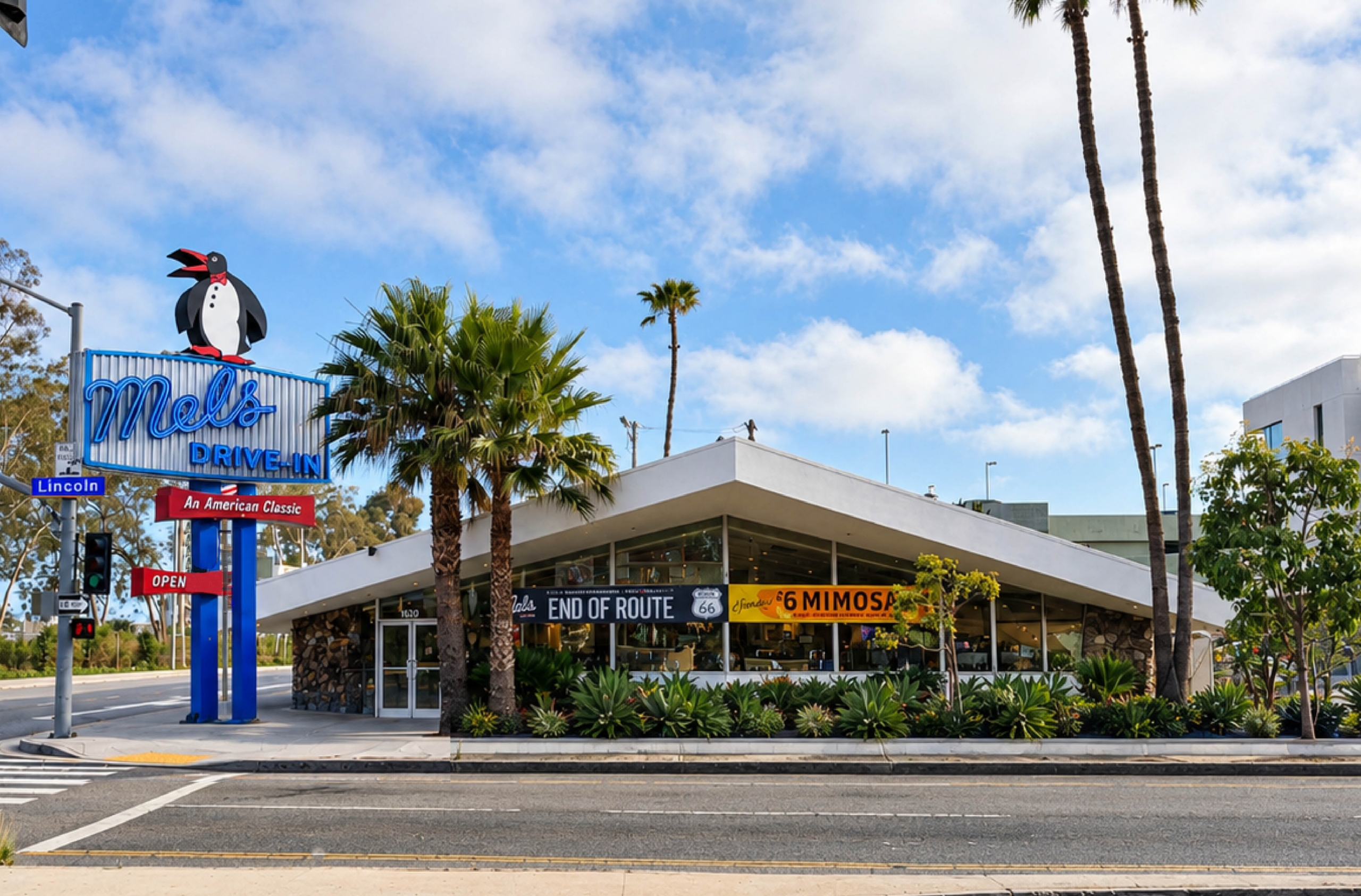 The Penguin Coffee Shop in 2026. Photo: Santa Monica Conservancy
During the Penguin’s 2019 rehabilitation, the original stone cladding was revealed after being hidden behind drywall. The Penguin-shaped sign that lured travelers for decades was refreshed. Inside, the terrazzo floors, as well as counter stools upholstered in leatherette material and cantilevered from a raised terrazzo curb, which serves as a footrest were recreated, as were the large globe-shaped interior light fixtures that were integral to the views of the Penguin from the street at night. The Santa Monica Conservancy honored Mel’s with a Historic Preservation Award in 2019.
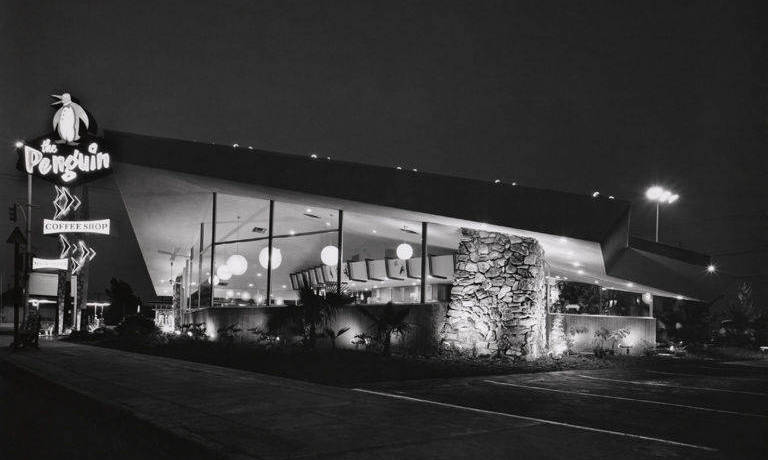 The Penguin Coffee Shop in 1959, designed by Architects Armet & Davis. Photo: Santa Monica Public Library
The architects of The Penguin, Armet & Davis, were outstanding practitioners of this style, creating over 4,000 buildings, many of which are notable examples in the Southern California region. Their designs have a notable anti-gravitational energy, creative innovation, and dramatic flair that distinguish their work. Surviving properties outside of Santa Monica include Norm’s in West Hollywood, various Bob’s Big Boy locations, Corky’s in Sherman Oaks and Pann’s in Westchester.
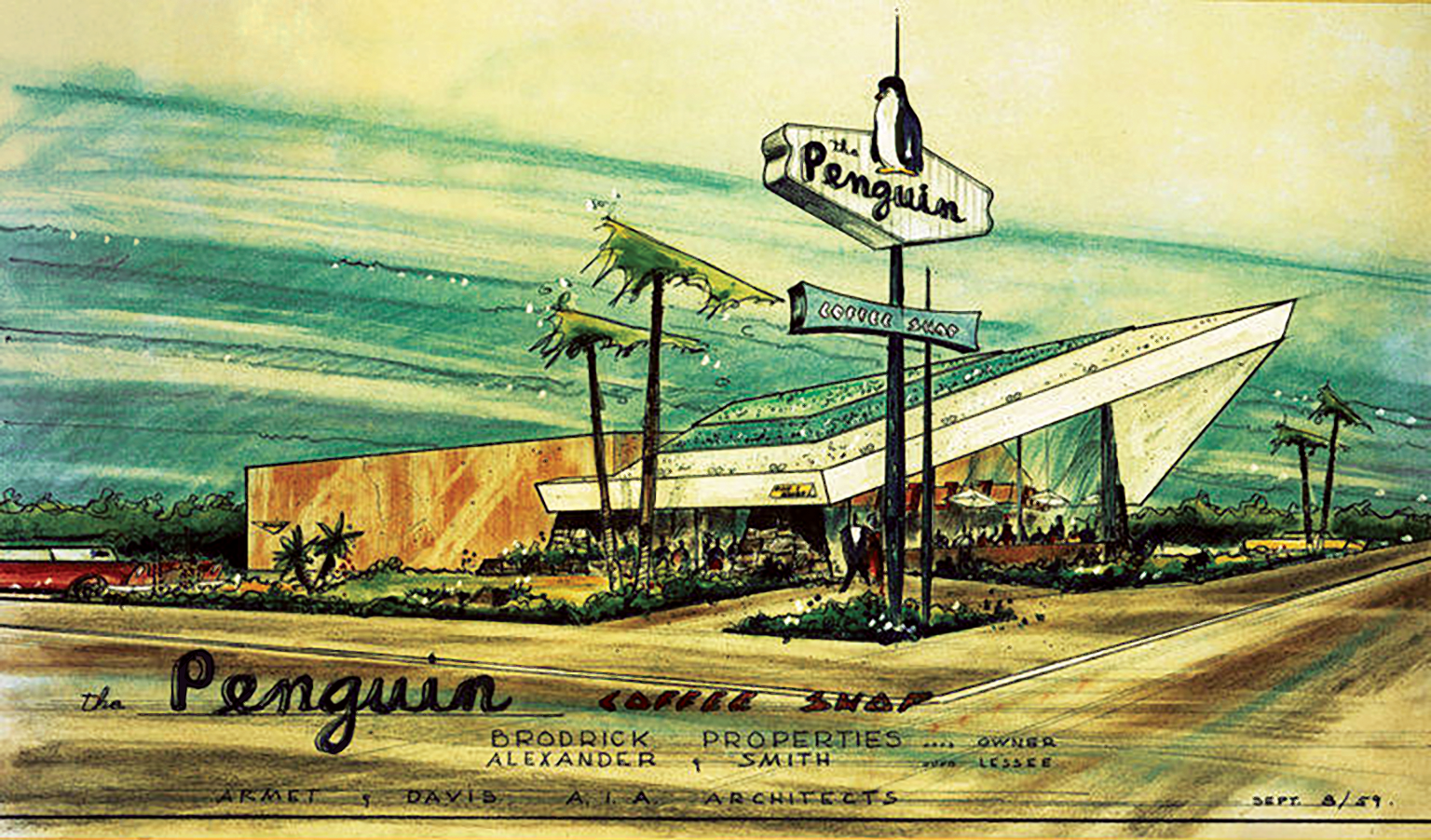 The Penguin Coffee Shop in 1959, designed by Architects Armet & Davis. Photo: Santa Monica Public Library
Many Googie-style coffee shops have been demolished and replaced by larger-scale commercial developments, making intact examples like the Penguin that remain even more significant. In Santa Monica, a Norms coffee shop once located at Lincoln Boulevard and Broadway, with Googie roof characteristics, glass walls, and prominent, distinctive signage, has been torn down, elevating the significance of The Penguin, which is the only surviving example of Coffee Shop Modernism in Santa Monica.
Sources:
Googie Redux: Ultramodern Roadside Architecture by Alan Hess
“The 1959 Googie style restaurant will become a Mel’s Drive-in,” Chris Nichols, Los Angeles Magazine, November 2, 2016.